Influence of hydrothermal aging on the shear bond strength of 3D printed denture-base resin to different relining materials

Influence of hydrothermal aging on the shear bond strength of 3D printed denture-base resin to different relining materials

This study assessed the repairability of 3D-printed denture bases by evaluating the bond performance of four conventional relining materials under clinically simulated conditions. Surface roughness and contact angle were characterized with and without sandblasting pretreatment, and shear bond strength was measured across three denture base types (3D-printed, heat-cured, and self-cured) before and after hydrothermal aging. Failure mode and fractured surface analyses provided additional insight into interfacial behavior. Results showed that 3D-printed denture bases exhibited repairability comparable to conventional counterparts, though bond strength declined after aging. Among the relining materials tested, Ufi Gel Hard demonstrated the highest bond strength with 3D-printed substrates, while Kooliner showed a tendency toward adhesive failure with heat- and self-cured bases. These findings offer practical guidance for selecting relining materials in the clinical repair of 3D-printed removable prostheses.

This study assessed the repairability of 3D-printed denture bases by evaluating the bond performance of four conventional relining materials under clinically simulated conditions. Surface roughness and contact angle were characterized with and without sandblasting pretreatment, and shear bond strength was measured across three denture base types (3D-printed, heat-cured, and self-cured) before and after hydrothermal aging. Failure mode and fractured surface analyses provided additional insight into interfacial behavior. Results showed that 3D-printed denture bases exhibited repairability comparable to conventional counterparts, though bond strength declined after aging. Among the relining materials tested, Ufi Gel Hard demonstrated the highest bond strength with 3D-printed substrates, while Kooliner showed a tendency toward adhesive failure with heat- and self-cured bases. These findings offer practical guidance for selecting relining materials in the clinical repair of 3D-printed removable prostheses.

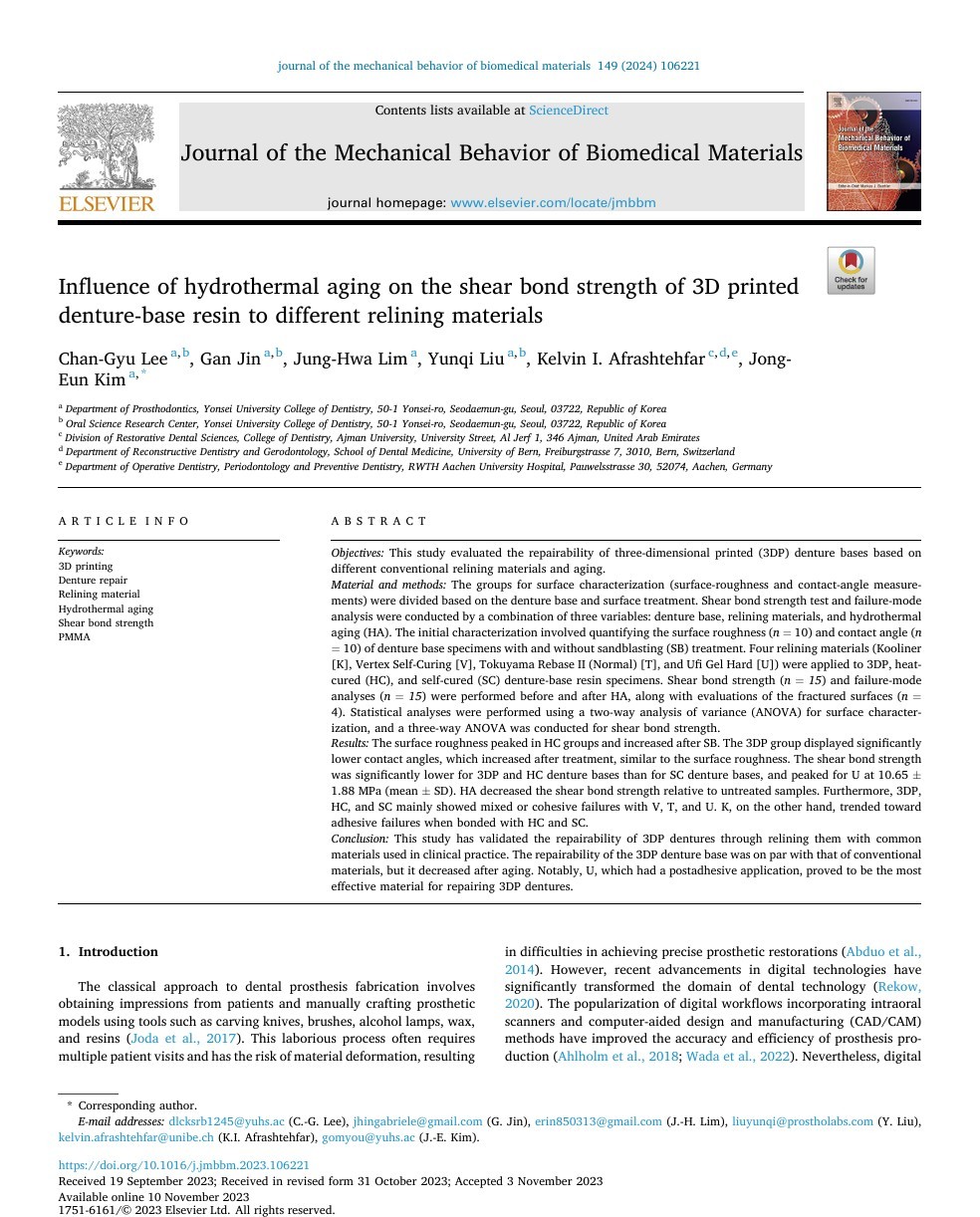
Objectives: This study evaluated the repairability of three-dimensional printed (3DP) denture bases based on different conventional relining materials and aging.

Material and methods: The groups for surface characterization (surface-roughness and contact-angle measurements) were divided based on the denture base and surface treatment. Shear bond strength test and failure-mode analysis were conducted by a combination of three variables: denture base, relining materials, and hydrothermal aging (HA). The initial characterization involved quantifying the surface roughness (n = 10) and contact angle (n = 10) of denture base specimens with and without sandblasting (SB) treatment. Four relining materials (Kooliner [K], Vertex Self-Curing [V], Tokuyama Rebase II (Normal) [T], and Ufi Gel Hard [U]) were applied to 3DP, heat-cured (HC), and self-cured (SC) denture-base resin specimens. Shear bond strength (n = 15) and failure-mode analyses (n = 15) were performed before and after HA, along with evaluations of the fractured surfaces (n = 4). Statistical analyses were performed using a two-way analysis of variance (ANOVA) for surface characterization, and a three-way ANOVA was conducted for shear bond strength.

Results: The surface roughness peaked in HC groups and increased after SB. The 3DP group displayed significantly lower contact angles, which increased after treatment, similar to the surface roughness. The shear bond strength was significantly lower for 3DP and HC denture bases than for SC denture bases, and peaked for U at 10.65 ± 1.88 MPa (mean ± SD). HA decreased the shear bond strength relative to untreated samples. Furthermore, 3DP, HC, and SC mainly showed mixed or cohesive failures with V, T, and U. K, on the other hand, trended toward adhesive failures when bonded with HC and SC.

Conclusion: This study has validated the repairability of 3DP dentures through relining them with common materials used in clinical practice. The repairability of the 3DP denture base was on par with that of conventional materials, but it decreased after aging. Notably, U, which had a postadhesive application, proved to be the most effective material for repairing 3DP dentures.
Read more articles