Effect of Thermal Aging on a Urethane Acrylate-based 3D Printing Resin Incorporated with Antibacterial Quaternary Ammonium Methacrylate
Effect of Thermal Aging on a Urethane Acrylate-based 3D Printing Resin Incorporated with Antibacterial Quaternary Ammonium Methacrylate
This study evaluated the effect of incorporating the quaternary ammonium monomer DMAHDM into a urethane acrylate-based 3D printing resin, with particular focus on how thermal aging modifies its performance over simulated clinical service. DMAHDM was added at concentrations of 0.25–1 wt%, and specimens were subjected to up to 5000 thermal cycles to simulate long-term intraoral aging. Degree of conversion, color stability, flexural strength, Vickers hardness, antibacterial effectiveness, and cytotoxicity were systematically assessed. Results revealed concentration- and aging-dependent trade-offs: higher DMAHDM levels and extended aging enhanced hardness and antibacterial activity but progressively compromised flexural strength and biocompatibility, while also inducing notable color shifts. These findings highlight the need to carefully balance DMAHDM concentration against aging-related property changes when designing antimicrobial 3D-printed dental resins for durable clinical use.
This study evaluated the effect of incorporating the quaternary ammonium monomer DMAHDM into a urethane acrylate-based 3D printing resin, with particular focus on how thermal aging modifies its performance over simulated clinical service. DMAHDM was added at concentrations of 0.25–1 wt%, and specimens were subjected to up to 5000 thermal cycles to simulate long-term intraoral aging. Degree of conversion, color stability, flexural strength, Vickers hardness, antibacterial effectiveness, and cytotoxicity were systematically assessed. Results revealed concentration- and aging-dependent trade-offs: higher DMAHDM levels and extended aging enhanced hardness and antibacterial activity but progressively compromised flexural strength and biocompatibility, while also inducing notable color shifts. These findings highlight the need to carefully balance DMAHDM concentration against aging-related property changes when designing antimicrobial 3D-printed dental resins for durable clinical use.
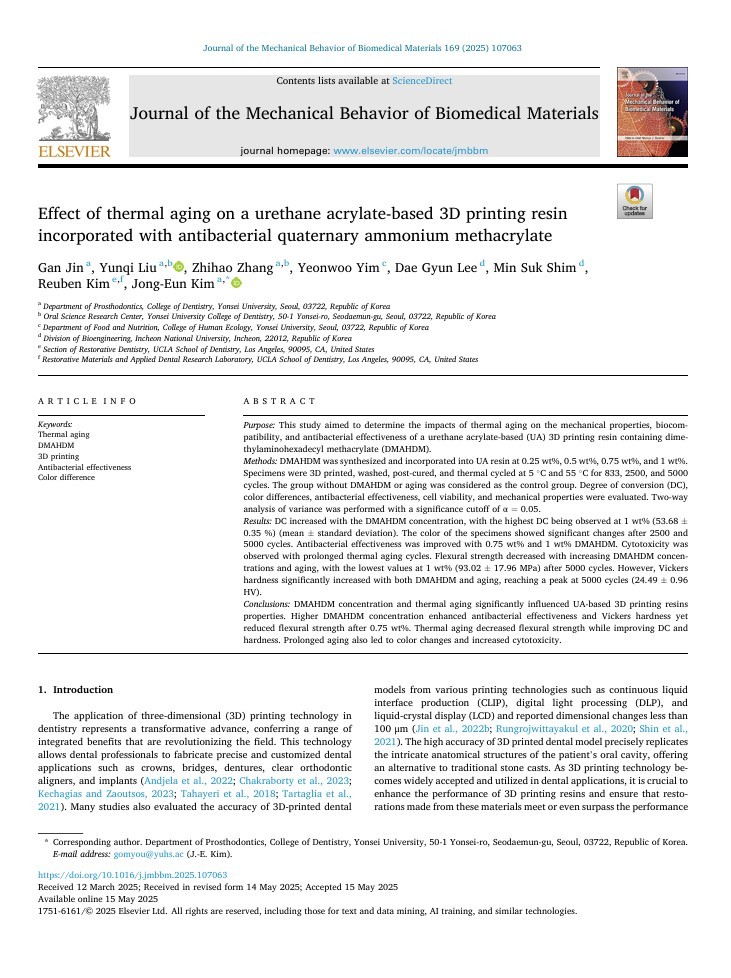
Purpose: This study aimed to determine the impacts of thermal aging on the mechanical properties, biocompatibility, and antibacterial effectiveness of a urethane acrylate-based (UA) 3D printing resin containing dimethylaminohexadecyl methacrylate (DMAHDM).
Methods: DMAHDM was synthesized and incorporated into UA resin at 0.25 wt%, 0.5 wt%, 0.75 wt%, and 1 wt%. Specimens were 3D printed, washed, post-cured, and thermal cycled at 5 °C and 55 °C for 833, 2500, and 5000 cycles. The group without DMAHDM or aging was considered as the control group. Degree of conversion (DC), color differences, antibacterial effectiveness, cell viability, and mechanical properties were evaluated. Two-way analysis of variance was performed with a significance cutoff of α = 0.05.
Results: DC increased with the DMAHDM concentration, with the highest DC being observed at 1 wt% (53.68 ± 0.35 %) (mean ± standard deviation). The color of the specimens showed significant changes after 2500 and 5000 cycles. Antibacterial effectiveness was improved with 0.75 wt% and 1 wt% DMAHDM. Cytotoxicity was observed with prolonged thermal aging cycles. Flexural strength decreased with increasing DMAHDM concentrations and aging, with the lowest values at 1 wt% (93.02 ± 17.96 MPa) after 5000 cycles. However, Vickers hardness significantly increased with both DMAHDM and aging, reaching a peak at 5000 cycles (24.49 ± 0.96 HV).
Conclusions: DMAHDM concentration and thermal aging significantly influenced UA-based 3D printing resins properties. Higher DMAHDM concentration enhanced antibacterial effectiveness and Vickers hardness yet reduced flexural strength after 0.75 wt%. Thermal aging decreased flexural strength while improving DC and hardness. Prolonged aging also led to color changes and increased cytotoxicity.