Antimicrobial DMAHDM nanoparticle-modified resin for 3D printing: Composition–Property relationships
Antimicrobial DMAHDM nanoparticle-modified resin for 3D printing: Composition–Property relationships
This study investigated the effects of dimethylaminohexadecyl methacrylate (DMAHDM) nanoparticles (0–1 wt%) incorporated into urethane acrylate (UA)-based 3D-printing resin on antibacterial/antifungal activity, biocompatibility, degree of conversion (DC), and mechanical properties. Results showed dose-dependent inhibition of S. mutans and C. albicans, no cytotoxicity, improved DC at higher DMAHDM concentrations, and slightly reduced but competitive flexural strength and hardness, supporting its potential for dental 3D-printing applications.
This study investigated the effects of dimethylaminohexadecyl methacrylate (DMAHDM) nanoparticles (0–1 wt%) incorporated into urethane acrylate (UA)-based 3D-printing resin on antibacterial/antifungal activity, biocompatibility, degree of conversion (DC), and mechanical properties. Results showed dose-dependent inhibition of S. mutans and C. albicans, no cytotoxicity, improved DC at higher DMAHDM concentrations, and slightly reduced but competitive flexural strength and hardness, supporting its potential for dental 3D-printing applications.
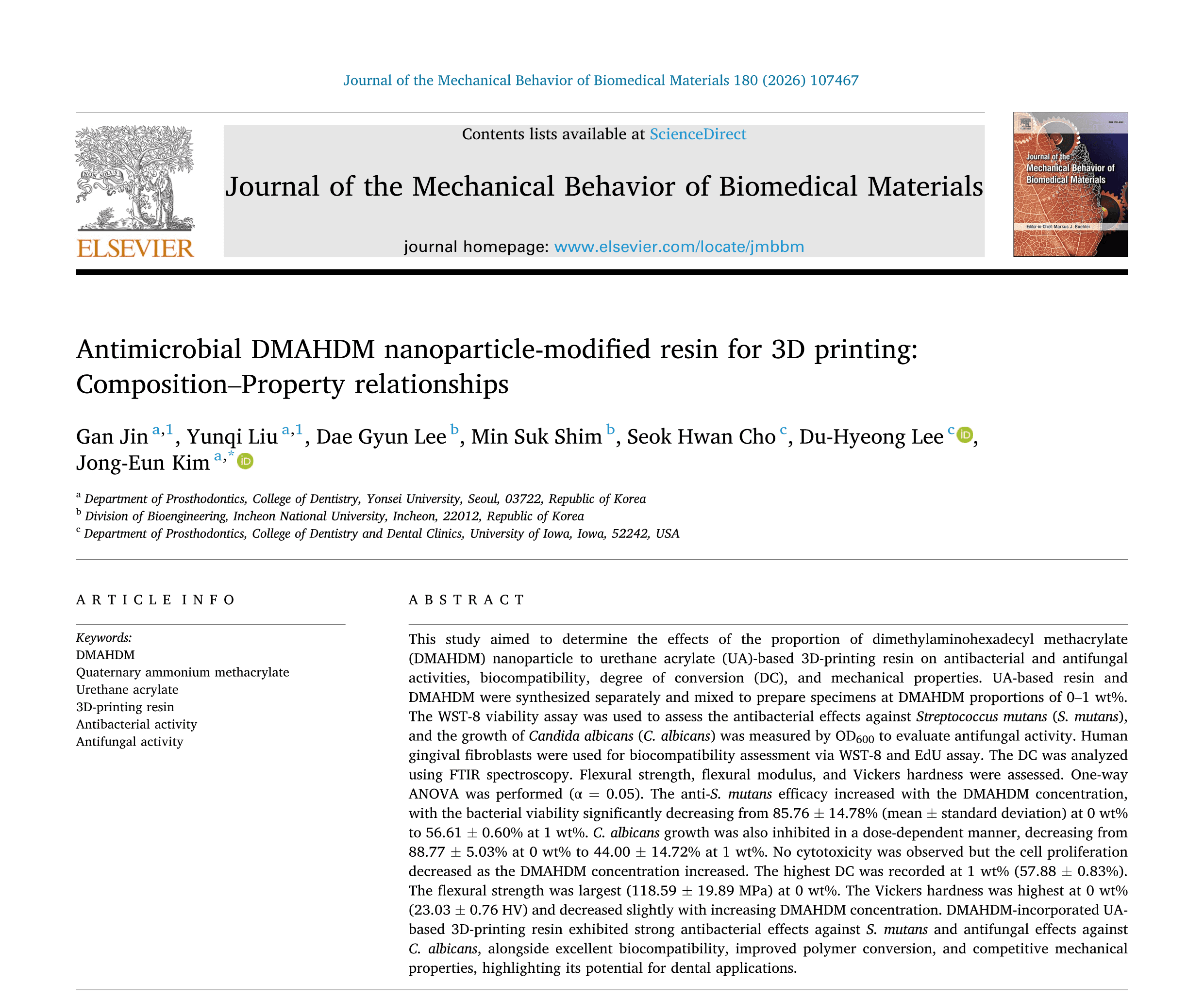
This study aimed to determine the effects of the proportion of dimethylaminohexadecyl methacrylate (DMAHDM) nanoparticle to urethane acrylate (UA)-based 3D-printing resin on antibacterial and antifungal activities, biocompatibility, degree of conversion (DC), and mechanical properties. UA-based resin and DMAHDM were synthesized separately and mixed to prepare specimens at DMAHDM proportions of 0–1 wt%. The WST-8 viability assay was used to assess the antibacterial effects against Streptococcus mutans (S. mutans), and the growth of Candida albicans (C. albicans) was measured by OD600 to evaluate antifungal activity. Human gingival fibroblasts were used for biocompatibility assessment via WST-8 and EdU assay. The DC was analyzed using FTIR spectroscopy. Flexural strength, flexural modulus, and Vickers hardness were assessed. One-way ANOVA was performed (α = 0.05). The anti-S. mutans efficacy increased with the DMAHDM concentration, with the bacterial viability significantly decreasing from 85.76 ± 14.78% (mean ± standard deviation) at 0 wt% to 56.61 ± 0.60% at 1 wt%. C. albicans growth was also inhibited in a dose-dependent manner, decreasing from 88.77 ± 5.03% at 0 wt% to 44.00 ± 14.72% at 1 wt%. No cytotoxicity was observed but the cell proliferation decreased as the DMAHDM concentration increased. The highest DC was recorded at 1 wt% (57.88 ± 0.83%). The flexural strength was largest (118.59 ± 19.89 MPa) at 0 wt%. The Vickers hardness was highest at 0 wt% (23.03 ± 0.76 HV) and decreased slightly with increasing DMAHDM concentration. DMAHDM-incorporated UA-based 3D-printing resin exhibited strong antibacterial effects against S. mutans and antifungal effects against C. albicans, alongside excellent biocompatibility, improved polymer conversion, and competitive mechanical properties, highlighting its potential for dental applications.