Effects of heat-treatment methods on cytocompatibility and mechanical properties of dental products 3D-printed using photopolymerized resin
Effects of heat-treatment methods on cytocompatibility and mechanical properties of dental products 3D-printed using photopolymerized resin
This study evaluated heat-treatment as a post-processing strategy to improve the cytocompatibility of DLP-printed dental photopolymer resins. Seven post-curing conditions were compared, ranging from room-temperature storage and water immersion to boiling water exposure and autoclaving, using NextDent C&B resin as the test material. Cell viability, cytotoxicity, confocal microscopy, and FTIR-based degree of conversion were assessed across groups. Results identified 100°C water immersion for 5 minutes as the most effective protocol, promoting preleaching of toxic residual monomers and photoinitiators while simultaneously increasing degree of conversion without compromising mechanical properties. These findings offer a simple, clinically accessible post-processing refinement to enhance the biological safety of 3D-printed dental restorations.
This study evaluated heat-treatment as a post-processing strategy to improve the cytocompatibility of DLP-printed dental photopolymer resins. Seven post-curing conditions were compared, ranging from room-temperature storage and water immersion to boiling water exposure and autoclaving, using NextDent C&B resin as the test material. Cell viability, cytotoxicity, confocal microscopy, and FTIR-based degree of conversion were assessed across groups. Results identified 100°C water immersion for 5 minutes as the most effective protocol, promoting preleaching of toxic residual monomers and photoinitiators while simultaneously increasing degree of conversion without compromising mechanical properties. These findings offer a simple, clinically accessible post-processing refinement to enhance the biological safety of 3D-printed dental restorations.
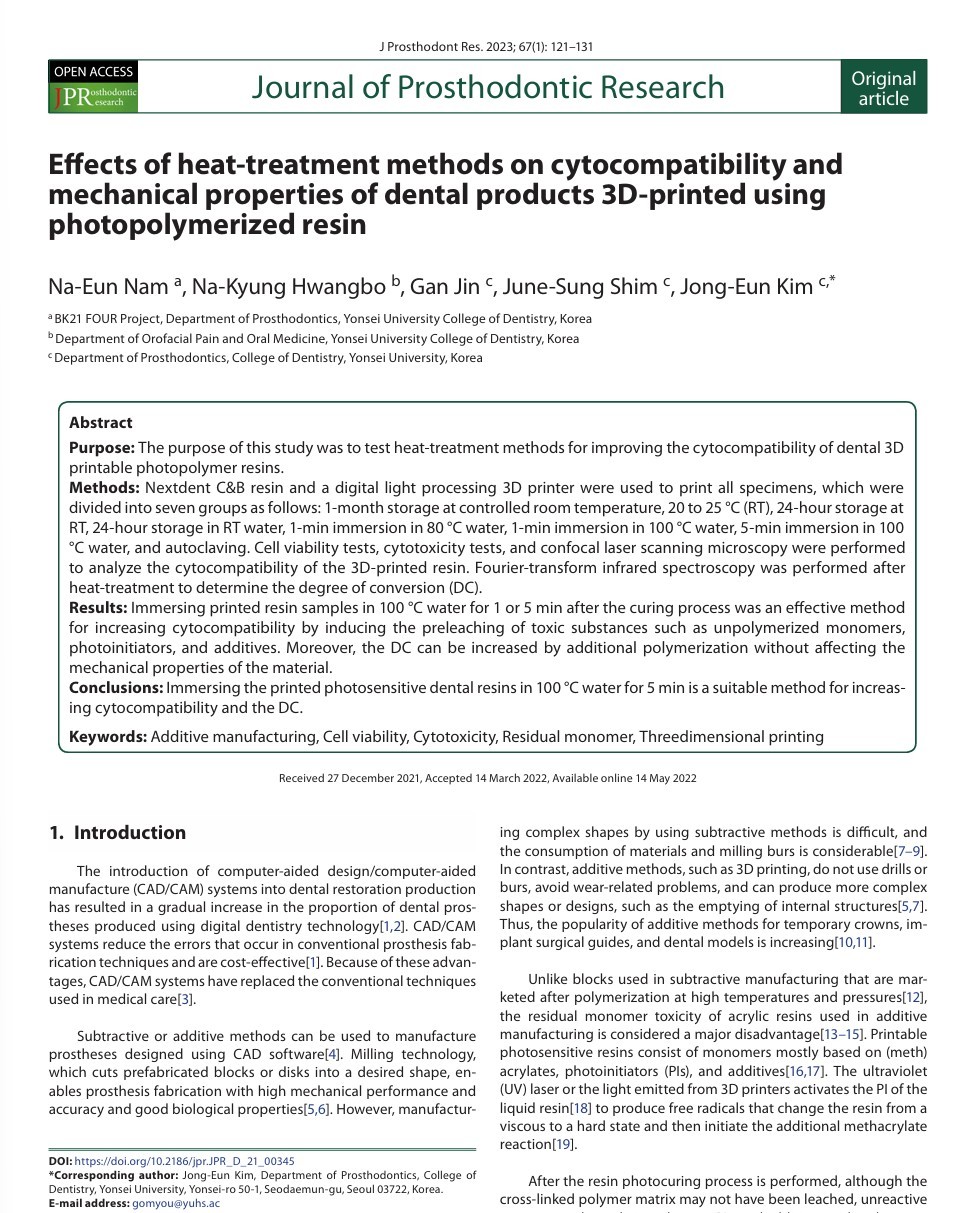
Purpose: The purpose of this study was to test heat-treatment methods for improving the cytocompatibility of dental 3D printable photopolymer resins.
Methods: Nextdent C&B resin and a digital light processing 3D printer were used to print all specimens, which were divided into seven groups as follows: 1-month storage at controlled room temperature, 20 to 25 °C (RT), 24-hour storage at RT, 24-hour storage in RT water, 1-min immersion in 80 °C water, 1-min immersion in 100 °C water, 5-min immersion in 100 °C water, and autoclaving. Cell viability tests, cytotoxicity tests, and confocal laser scanning microscopy were performed to analyze the cytocompatibility of the 3D-printed resin. Fourier-transform infrared spectroscopy was performed after heat-treatment to determine the degree of conversion (DC).
Results: Immersing printed resin samples in 100 °C water for 1 or 5 min after the curing process was an effective method for increasing cytocompatibility by inducing the preleaching of toxic substances such as unpolymerized monomers, photoinitiators, and additives. Moreover, the DC can be increased by additional polymerization without affecting the mechanical properties of the material.
Conclusions: Immersing the printed photosensitive dental resins in 100 °C water for 5 min is a suitable method for increasing cytocompatibility and the DC.